Energy Renovation in Provence Insulation, windows and heating that work in both seasons
A stone farmhouse that stays cool in July can still cost a fortune to heat in February, and a 1980s villa with single glazing often manages neither. Energy renovation in Provence means dealing with both seasons at once: keeping the southern sun out in summer, holding the heat in when the mistral blows in winter, and lifting the energy performance certificate (DPE), France's official A-to-G rating, to a level that protects the value of the property.
As your general contractor, ACR Provence plans and delivers the whole upgrade under one contract: roof and wall insulation, new windows, ventilation, heat pumps and hot water, with every trade scheduled so that nothing has to be undone later. You deal with one team, whether you live next door or in London, Chicago or Stockholm.
Request a free energy renovation quote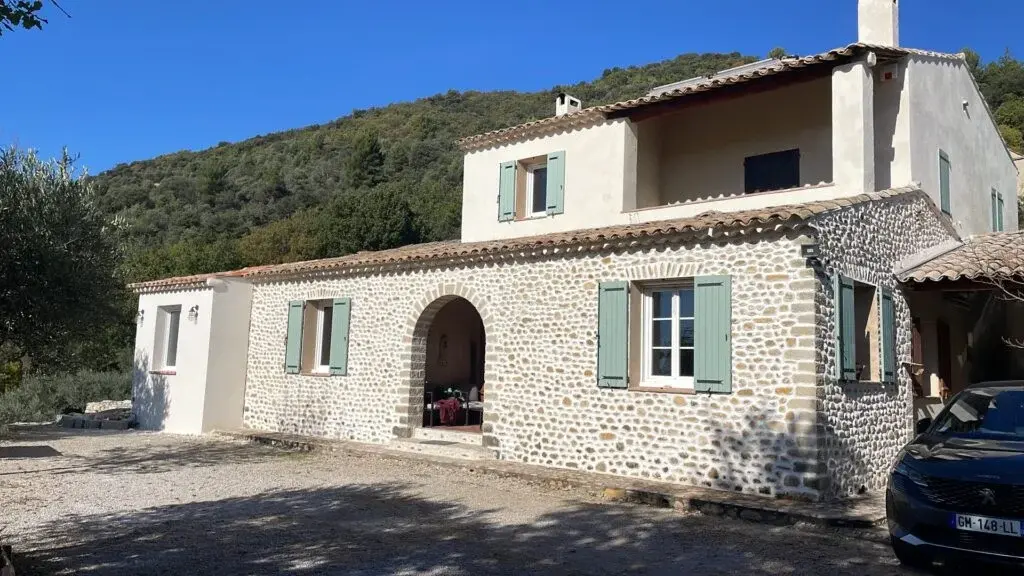
What an energy upgrade covers in a Provençal home
Most owners come to us with one idea in mind, usually a heat pump or new windows, when the biggest gain often lies elsewhere. We start with the building envelope and work inwards. These are the four areas we treat, separately or as one complete package:
Under a traditional Provençal tiled roof, attic spaces can turn into ovens by mid-afternoon in summer, then leak heat all winter. Insulating the roof is almost always the first and most cost-effective step of an energy renovation.
Depending on the layout, we blow loose-fill insulation into unused attic space, insulate between and under the rafters of a converted loft, or, when the roof covering is being redone anyway, lay the insulation over the rafters from outside. For summer comfort we favour dense materials such as wood fibre, which slow the heat of the day before it reaches the bedrooms.
External wall insulation wraps the house in an insulating layer that is then rendered. It removes most thermal bridges and leaves the rooms untouched, which makes it the preferred option on the concrete-block villas built from the 1960s to the 1990s.
Internal insulation suits houses whose facades must not change: protected streets, exposed stonework, walls built on the property line. On old stone walls we only use breathable systems such as hemp-lime, cork or wood fibre finished with lime plaster, so that moisture can still escape instead of being trapped behind plasterboard.
Replacing single glazing or tired double glazing cuts draughts and street noise, but new windows also make a house far more air-tight. Without proper ventilation, condensation and mould follow, especially in thick-walled houses that were designed to breathe through their gaps.
We therefore handle joinery and ventilation as one job: well-sealed frames in timber, aluminium or PVC to suit the building, shutters kept or restored for summer shading, and a humidity-controlled mechanical extract system that renews the air without wasting heat.
Old oil boilers and electric panel heaters are what drag many homes in the region down to an F or G rating. An air-to-water heat pump can replace the boiler and feed the existing radiators or underfloor heating, while an air-to-air system, known locally as reversible air conditioning, heats in winter and cools in summer.
Hot water can move to a heat-pump water heater, and suitable roofs can take solar panels. Because each of these systems is sized on how much heat the building loses, we select them once the insulation work is defined, so you never pay for a machine bigger than the house needs.
Four things that change when you insulate a house in the South of France
Methods designed for northern Europe do not transfer directly to Provence and the French Riviera. These are the points we check on every project before recommending a single product:
Inland, from the Alpilles to the hills of the Var, summer afternoons regularly climb into the mid-thirties Celsius (the mid-nineties Fahrenheit). An insulation scheme chosen only for its winter performance can trap that heat indoors and make bedrooms stuffy at night.
A good upgrade keeps the house cooler in August as well as warmer in January.
- Dense insulating materials that delay the afternoon heat peak
- Shutters and external shading kept, restored or added
- Night-time cross-ventilation considered in the layout
- Active cooling only where passive measures fall short
Mas, bastides and village houses were built with thick rubble-stone walls bound in lime. They manage moisture by letting it evaporate through the masonry. Cement renders and plastic vapour barriers block that process and push damp up into the rooms.
The aim is to work with the thermal mass these walls already have, not to bury it.
- Lime renders and plasters only on old masonry
- Insulating plasters such as hemp-lime or cork-lime
- Damp diagnosed and treated before any lining goes up
- Air-tightness handled at the roof and the windows
External insulation, new window styles, heat-pump outdoor units and solar panels all change how a house looks from the street. In most towns that means filing a déclaration préalable at the town hall and waiting for approval before work starts.
Near a listed monument or in a conservation area, the state heritage architect (Architecte des Bâtiments de France, ABF) reviews the file and may refuse external insulation or impose materials, colours and where equipment can go.
- Planning status checked at the first site visit
- Application prepared with drawings and photographs
- Outdoor units placed out of sight and away from neighbours
- Internal insulation as the fallback on protected facades
French energy grants such as MaPrimeRénov' and energy-saving certificates (CEE) are only paid when the work is carried out by RGE-certified contractors. ACR Provence does not hold the RGE label itself: for grant-funded work, we bring in RGE-certified partner companies and coordinate them on site.
Many of these schemes are also reserved for a main residence, so a holiday home owned from abroad often does not qualify.
- RGE partners used wherever a grant is being sought
- Eligibility checked case by case, never promised
- Invoices and certificates organised for your file
- A budget that stands on its own without subsidies
The right order: building fabric first, heating last
Doing the work in the wrong order is the most expensive mistake in energy renovation: a heat pump sized for a leaky house becomes oversized, noisy and inefficient once the roof is insulated. This is the sequence we follow on every project:
Before any quote, we need to know where the house actually loses energy.
- Rating: the existing DPE is reviewed, or a new one is ordered from a certified assessor if it is missing or out of date.
- Survey: roof, walls, floors, joinery, ventilation and heating are inspected on site.
- Priorities: the works are ranked by comfort gain and by their effect on the rating.
Insulation comes first because it reduces every need that follows.
- Roof: attic or rafter insulation, with the summer-heat criteria described above.
- Walls: an external or internal system matched to the way the house was built.
- Floors: insulation under floors above unheated cellars or crawl spaces where they can be reached.
Once the walls are defined, the openings can be fitted in the right position.
- Joinery: new windows set in line with the insulation layer to avoid cold edges.
- Shading: shutters or blinds restored or fitted on the sunniest elevations.
- Ventilation: installed as soon as the house becomes air-tight, never afterwards.
The equipment is chosen last, for the house as it now performs.
- Sizing: heat pump or boiler replacement calculated on the reduced heat loss.
- Hot water and solar: connected and commissioned with the heating system.
- Handover: a new DPE, user instructions and warranty documents; what each warranty covers is explained in our guide to guarantees and after-sales service.
Three types of home, three different upgrades
The right package depends first on how the house was built. This is what we typically recommend for the kinds of property that overseas owners most often buy in the region:
Their thermal mass keeps them pleasant in summer, but uninsulated roofs, single glazing and ageing oil boilers make winters expensive.
Typical works: roof insulation, lime-based insulating plasters, timber double glazing, a heat pump in place of oil heating.
A frequent source of F and G ratings on the resale market: settled or missing attic insulation, uninsulated block walls, electric heaters or oil.
Typical works: external wall insulation, an attic top-up, new windows and an air-to-water or air-to-air heat pump.
Mild winters shift the priority to summer cooling and humidity. In apartment buildings, facades and roofs belong to the co-ownership (copropriété), so individual owners mainly act on windows, internal insulation and equipment.
Typical works: new glazing, reversible air conditioning, ventilation and internal insulation of exposed walls.
Energy renovation questions from overseas owners
Do I need a DPE to sell or let my house in France?
Yes. A valid DPE must be included in the sale file handled by the notary (notaire), and the rating must appear in any sale or rental advertisement. A poor rating does not prevent a sale, but buyers and their banks look at it closely, and it now limits long-term letting (see below). If you are about to buy, the purchase side of the process is covered in our guide to buying and renovating a property in Provence.
Can I claim French grants for a holiday home?
Usually not for the main scheme: MaPrimeRénov' is aimed at main residences, meaning homes occupied at least eight months a year. Some energy-saving certificate bonuses and local schemes follow different rules, which is why we check eligibility case by case and never build a quote that depends on a grant you may not receive.
Is ACR Provence RGE-certified?
No. ACR Provence is a general contractor and does not hold the RGE label itself. When a project is aimed at state grants, the relevant work is carried out by RGE-certified partner companies that we select and coordinate, so you keep a single point of contact and a single schedule.
Can the work go ahead while we are living abroad?
Yes. Insulation, window and heating works do not require you to be in France, as long as access to the property and key decisions are organised in advance. The way we run projects for non-resident owners is explained on our renovation project management page.
How much should I budget for an energy renovation?
It depends on the size of the house, how it was built, how many steps you take and which heating system is chosen: topping up an attic and rebuilding the envelope of a stone house are very different jobs. Our renovation cost guide for Provence explains the main budget drivers, and our free quote, sent within 48 hours, breaks the price down trade by trade.
Where we carry out energy renovation work
Our four agencies cover the Bouches-du-Rhône, the Var, the Vaucluse and the Alpes-Maritimes, from the Alpilles and the Luberon to the French Riviera (Côte d'Azur):
Continue your research:
Renovation costs in Provence | Guarantees and after-sales service | Buying and renovating in Provence
Letting your property: what the DPE rating now decides
If you plan to rent out your home in Provence on a long-term lease, the energy rating has become a legal threshold rather than a label. Under France's Climate and Resilience Act, the lowest-rated homes are progressively treated as unfit to let on new or renewed leases:
Class G
Since 1 January 2025, G-rated homes can no longer be offered on new or renewed long-term leases.
Class F
The same rule is scheduled to apply to F-rated homes from 1 January 2028.
Class E
E-rated homes are due to follow from 1 January 2034.
Rents on F- and G-rated homes have also been frozen since August 2022. Short-term holiday lets follow their own, changing rules, so confirm your situation with your notaire or letting agent. Moving a house up one or two classes often comes down to the roof, the heating system and the windows, carried out in the order described above.
Plan your energy upgrade with ACR Provence
Send us a few details about the house and your current DPE if you have one. You will receive a free, itemised quote within 48 hours, and the completed works are covered by our 10-year warranty.