Villa renovation in Saint-Rémy-de-Provence Farmhouses, village houses and family villas in the Alpilles
Saint-Rémy-de-Provence sits on the northern edge of the Alpilles, a small limestone range between Avignon and Arles. Its old town, circled by boulevards shaded by plane trees, is surrounded by olive groves, market gardens watered by canals and, on the lower slopes, some of the most sought-after villas and farmhouses in Provence. Many of them now belong to British, American and Northern European owners who spend part of the year here.
Renovating one of these properties is rarely just a matter of a new kitchen and fresh paint. Heritage rules around the town's listed monuments, the Mistral, fire-prevention duties at the foot of the hills and old stone walls that need to breathe all shape what can be done, and how. ACR Provence is a general building contractor that coordinates every trade on your villa, from structural work to the final finishes, from our Cavaillon agency a short drive away across the Durance.
Request a free quote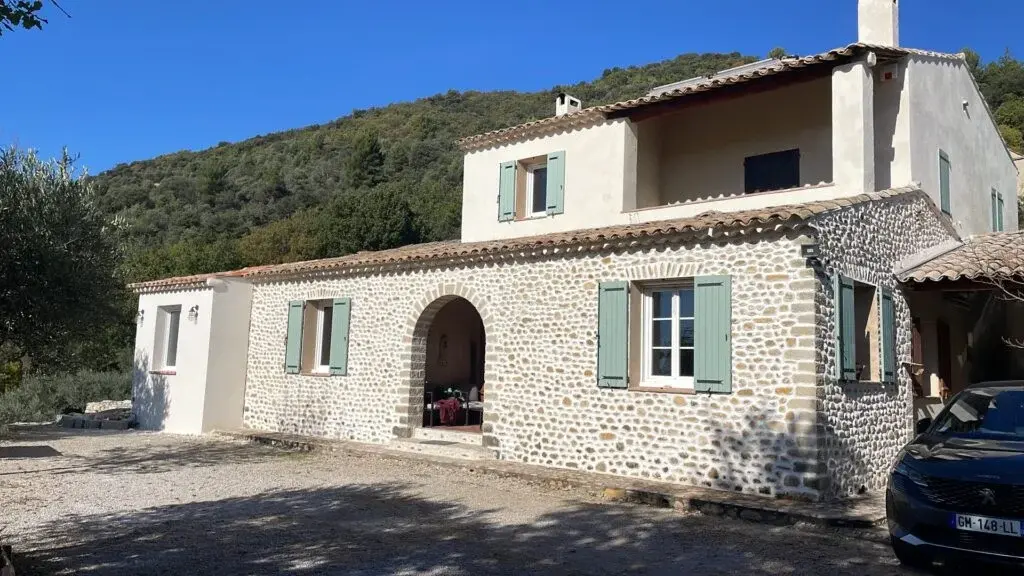
Which kind of Saint-Rémy property are you renovating?
Around Saint-Rémy, the house you buy largely decides the renovation you will face. These are the four types of property we come across most often between the town, the farmland of the plain and the foothills of the Alpilles.
Long, low mas built in rubble limestone, with a génoise cornice of stacked tiles under the eaves, often extended over the generations with barns, stables and a hayloft. They stand among orchards and fields crossed by irrigation canals, sometimes at the end of an unpaved lane. Buyers usually want to bring the outbuildings into the living space, open up the ground floor and create a pool without losing the character that made them fall for the place.
The surprises are usually hidden: floors laid straight onto earth, damp at the foot of the walls, beams weakened by wood-boring insects and a wastewater system from another era. The craft side of this work is covered on our page about farmhouse (mas) renovation in Provence.
Tall, narrow houses on two or three floors, sharing walls with their neighbours and opening onto lanes too narrow for a lorry. Some hide a small courtyard or a roof terrace looking out over the tiled roofs. They make charming town homes but need careful planning: materials are often carried in by hand, and deliveries have to be organised around the lanes and the busy Wednesday market.
Most of this area lies within the protected surroundings of historic monuments, so any change to the façade, shutters, windows or roof is reviewed by the state heritage architect (Architecte des Bâtiments de France, ABF).
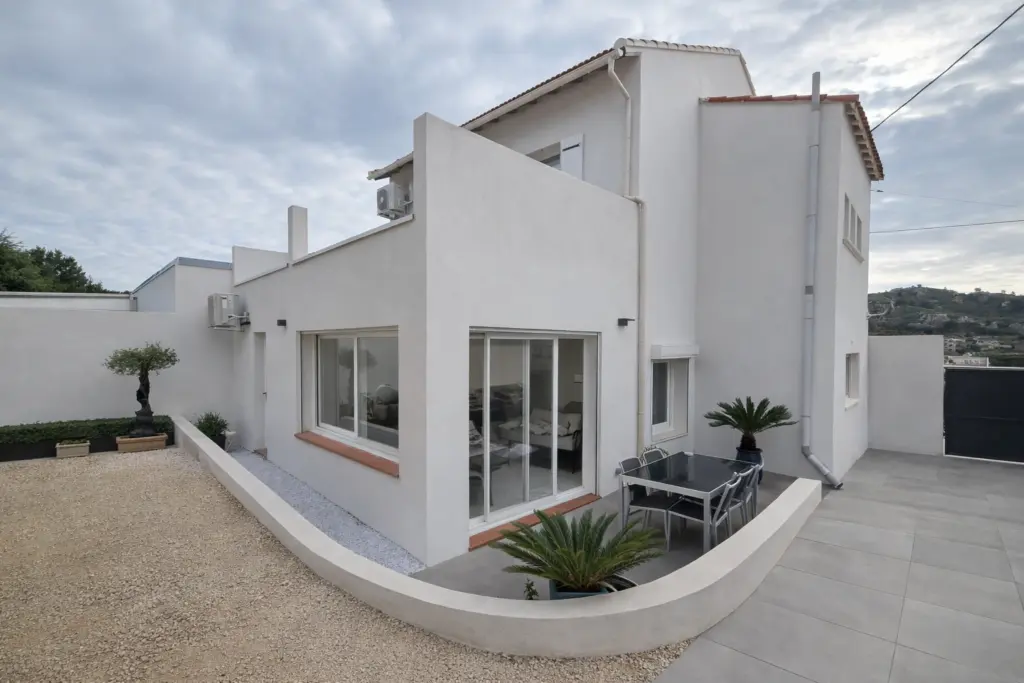
Built from the 1970s to the early 2000s in concrete block, with rendered walls, arched openings and terracotta floors, these villas were designed for summer holidays. Their structure is generally sound, but the layouts feel closed, the insulation is thin and the kitchens and bathrooms have aged.
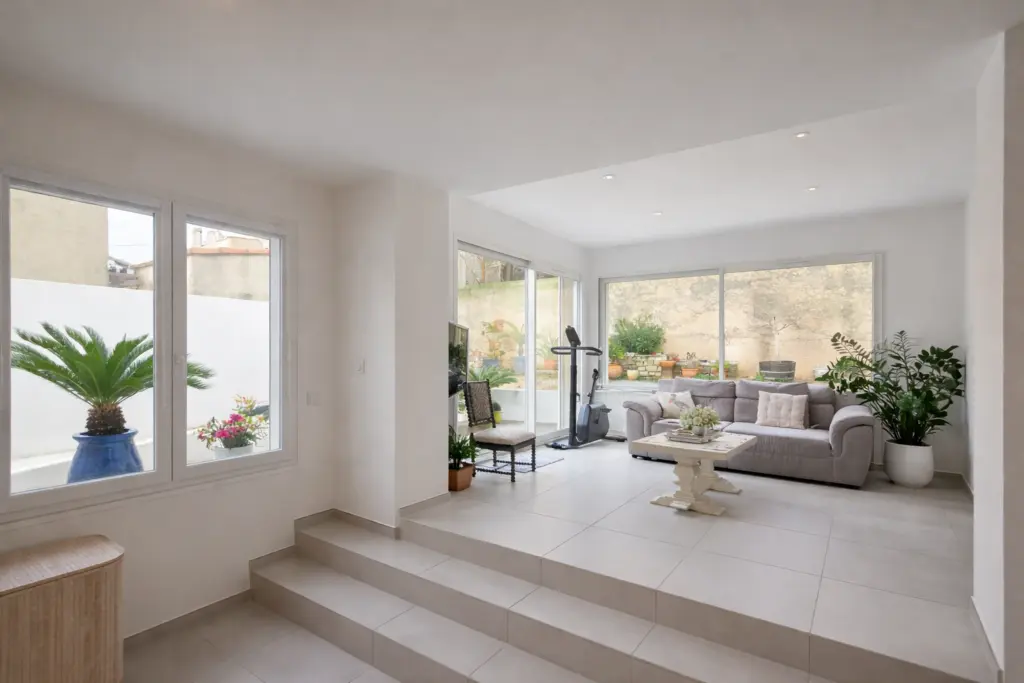
Owners typically open up the living areas, create a master suite, replace the joinery with double-glazed windows that suit the style and give the pool surround and terraces a new lease of life. It is often the quickest route to a comfortable home that can also be let during the season.
Larger plots at the foot of the Alpilles, often with a pool, a guest house and long views over the olive trees. These properties usually belong to people who live abroad for most of the year and want the house ready for summer, with works that keep to schedule and a clear point of contact while they are away.
Here the renovation mixes high-end interior finishes with outdoor work: stone terraces, shaded summer kitchens, pool upgrades and landscaping, all within the fire-prevention rules that apply close to the woods.
Four local constraints that shape a villa renovation in Saint-Rémy
The charm of Saint-Rémy comes with rules and a climate that a builder from elsewhere can easily underestimate. These are the points we check on every property before we price the work.
Saint-Rémy is home to the Roman site of Glanum, the monastery of Saint-Paul-de-Mausole, where Van Gogh painted during his stay in 1889–1890, and a historic centre full of listed buildings. Around each of these monuments, a protected perimeter means that exterior work is reviewed by the ABF before it can go ahead.
In practice, even replacing windows or changing the colour of a render calls for a prior declaration (déclaration préalable), while an extension or a significant change of volume may need full planning permission (permis de construire). The heritage review adds time to the process and can lead to requests on materials, colours and proportions.
- Traditional materials: lime, canal tiles, painted timber
- Muted façade colours in keeping with the street
- Solar panels and air-conditioning units kept out of sight
- Rules for your plot checked before the quote
The Mistral funnels down the Rhône valley and sweeps across the plain north of the Alpilles, sometimes for several days in a row. Traditional farmhouses turn an almost blind north wall to it and open to the south; a renovation that adds large glazed openings on the wrong side can leave a house cold in winter and hard to keep cool in summer.
Summers are long and hot, so shade, thermal mass and ventilation count as much as insulation. The thick stone walls of an old mas are an asset, provided they are treated with materials that let them breathe.
- Tiles carefully fixed on ridges and exposed verges
- Shutters and pergolas designed to withstand gusts
- New openings placed with orientation in mind
- Breathable insulation for old stone walls
The pine and holm-oak woods of the Alpilles, protected as a regional nature park, are classified as a wildfire risk area. Owners of properties in or near these woods have a legal duty to clear brushwood around their buildings (obligations légales de débroussaillement), and the local urban plan (plan local d'urbanisme, PLU) can restrict building in the most exposed sectors.
For a renovation, this matters in two ways: some extensions or outbuildings may be limited, and outdoor works such as terraces, planting, pool areas and access for fire engines should be designed with the clearing rules in mind.
- Constraints for your plot read in the PLU
- Low-flammability materials for outdoor structures
- Roofs and gutters easy to keep clear of needles
- Access lanes wide enough for emergency vehicles
The plain north of the town is crossed by irrigation canals that have fed its market gardens for centuries. Properties along them can face a high water table in wet seasons, and some soils contain clay that swells and shrinks with the weather, which affects foundations, terraces and pool shells.
Many farmhouses outside the town are not connected to mains sewerage and rely on a private wastewater system. Its condition is reported in the diagnostics handed over by the notary (notaire) at the sale, and a renovation that adds bedrooms usually means upgrading it.
- Soil study before new foundations or a pool shell
- Perimeter drains where water collects
- Wastewater system sized to the new number of rooms
- Canal banks and rights of way respected during works
What to expect according to the age of your house
The age of a property says a great deal about the work it will need. This is how priorities usually shift from one generation of house to the next around Saint-Rémy.
Rubble stone, lime mortar and timber floors: beautiful, but built with no damp-proofing and no insulation.
- Roof and timbers: check beams and battens, re-lay the canal tiles and restore the génoise.
- Walls: remove cement renders that trap moisture and return to lime.
- Services: replace lead or galvanised pipes and rewire the whole house.
Many mas gained concrete additions, lean-to sheds and new floors during this period, not always well tied into the original stone.
- Junctions: cracks where old stone meets newer masonry.
- Floors: early concrete slabs with no insulation underneath.
- Openings: windows enlarged at the expense of the lintels.
Sound concrete-block houses whose weak points are energy performance and dated layouts.
- Energy: a poor rating on the energy performance certificate (diagnostic de performance énergétique, DPE) calls for roof insulation, new glazing and a modern heating system.
- Layout: kitchen opened onto the living room, master suite created.
- Outdoors: pool surround, terrace paving and pergolas renewed.
Built to modern standards, these houses mainly call for personalisation.
- Interiors: bathrooms and kitchens redesigned to your taste.
- Outdoors: pool house, summer kitchen or shaded terrace.
- Smart home: remote control of heating, shutters and alarm, useful when you live abroad.
Saint-Rémy sector by sector
Within the same commune, the constraints change a lot between the historic centre, the slopes of the Alpilles and the farmland of the plain.
Narrow lanes, fountains and townhouses gathered around the collegiate church of Saint-Martin, encircled by shaded boulevards lined with cafés.
Typical work: full interior renovation of townhouses, lime façades, roof terraces, discreet air conditioning.
Lanes climbing gently towards the hills, where villas and restored mas enjoy large gardens, pools and views of the rocky ridges.
Typical work: whole-house renovation, outdoor living spaces, pool upgrades and landscaping.
Flat farmland of orchards and market gardens, crossed by canals and dotted with isolated mas and former farm buildings.
Typical work: barn conversions, new insulated floors, private drainage upgrades, extensions.
What to send us for an accurate quote on a Saint-Rémy property
Many owners here are not in France when they first get in touch. A few documents and photos help us understand the property before the site visit and make that visit far more productive.
Plans if you have them and the diagnostics from the sale, including the energy certificate (DPE) and the wastewater report.
Photos of each room, the roof and the façades, plus a word on the access lane, gates and parking for delivery vehicles.
What you would like to change, the periods you will spend in Provence and when you hope to move in or let the house.
Once the job is handed over, structural work is covered by the garantie décennale; our guide to guarantees and after-sales service in France explains what it covers and how to make a claim.
Your questions about renovating in Saint-Rémy-de-Provence
How can I find out whether my property is in a protected heritage area?
The simplest way is to ask the town planning department for an urban planning certificate (certificat d'urbanisme) or to consult the PLU, which shows the protected perimeters around historic monuments. If you are still buying, your notary will include this information in the sale file. We also check it before preparing the quote, because it affects the materials, the timing and the paperwork required.
What does the brush-clearing obligation mean for my garden?
If your property is in or near the wooded areas of the Alpilles, you must keep the vegetation around your buildings cleared and thinned to a set standard and maintain it every year. It does not rule out a beautiful garden, but it guides the choice and spacing of trees, hedges and outdoor structures. We design terraces, pergolas and planting with these rules in mind so the result stays compliant.
My farmhouse is not connected to mains sewerage. Is that a problem?
Not necessarily: it is common outside the town. The report on the private wastewater system in your sale diagnostics tells you whether it complies. If you plan to add bedrooms or a guest house, the system usually has to be resized, and the new design must be approved by the local public service in charge of private drainage (SPANC) before work begins.
When is the best time of year to renovate in Saint-Rémy?
Interior work can go ahead all year round. Lime renders and façade work are best carried out in mild, dry weather, away from frost and the peak heat of summer. If you want the house ready for the season, it is wise to contact us in the autumn: that leaves time for the quote, any planning application and the works themselves.
Which ACR Provence agency looks after Saint-Rémy-de-Provence?
Our Cavaillon agency, at 302 Cr Sadi Carnot, 84300 Cavaillon, is the closest, just across the Durance, and our Salon-de-Provence agency at 378 Bd Georges Clemenceau also covers the Alpilles. To see how we keep owners informed while they are abroad, read our guide to managing a renovation in Provence from abroad.
Villages around Saint-Rémy that we cover
From our Cavaillon and Salon-de-Provence agencies, we work throughout the Alpilles and the countryside between the Durance and the Rhône:
Further east, across the Durance, our page on renovation in the Luberon covers the hill villages of the Vaucluse.
Your villa in Saint-Rémy-de-Provence
Tell us about your property and your plans: we reply with a free quote within 48 hours. Planning a project elsewhere in the region? Our Provence page lists every area we cover.